On Android Chrome, tap ⋮ → Downloads, then tap the PDF to open it. On a computer, check your browser’s Downloads list or Downloads folder.
A “Download again?” message usually means a file with that name is already in your downloads. Check there before requesting another copy.
Open the PDF in your browser or a PDF reader to print. On Android Chrome, use ⋮ → Share → Print. Check the paper size and 50 mm ruler; if your print app cannot use Actual size, print from a PDF app or computer that can.
Ask library staff, an outreach worker or reception at a listed help center: “I need food, a place to stay, or help with drugs or alcohol. Where can I go, when, and what should I bring?”
Enter a ZIP below for a listed desk when available. Ask staff to help contact services and check intake rules, hours and transport. If a service cannot help, ask for another option or help calling 211.
You are welcome to keep the food. Using these services is your choice.
Find help by ZIP code.
Choose the area where help is needed. You can read the next steps here or print them on a box.
Use city and state to find a ZIP code
YOUR LOCAL NEXT STEPS
Your local next steps
Choose what you need first. Read each contact’s intake rules; you can choose another provider. Distances are estimates from the ZIP center. Food, shelter, recovery and work help can be pursued in any order.
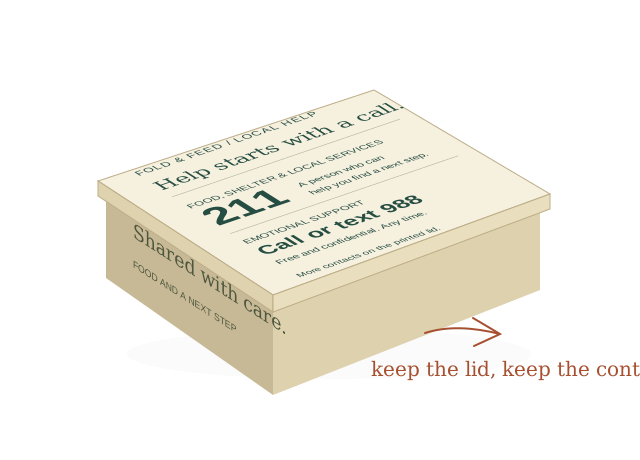
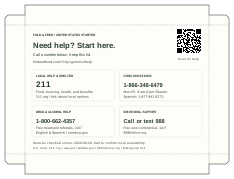
Print pages 1–2 on cardstock, single-sided, landscape, at 100% / Actual size. The lid has contacts, a START HERE side for help without a phone, a backup desk when listed, and words you can show staff. The tray has three-step guides on its outside walls. Page 3 is a plain-paper guide to tuck inside; page 4 explains assembly. Your ZIP is printed on the box and included in its help QR code. The PDF is prepared on your device.
Sources for these steps
Source dates shown with each listing
More nearby help
Distances are estimates from the ZIP center, not walking routes. These are directory listings, with individually checked contacts identified. Ask staff to help confirm intake, hours, eligibility and transport. Food-bank offices and 211 contacts provide referrals; get the actual place to go before traveling.
No nearby options in this category yet. Try All help, a wider distance or the directories below.
Need another option? Call 211 for local referrals.
Need someone to talk to? Call 988 or text 988, 24/7.
Provider details come from published directories and our checked contacts. Directory dates are shown with each listing. An intake or referral address does not guarantee a bed, meal or appointment.
Tap a phone number to call or a street address for a map. You can zoom in for a closer look.
Cut FoldTray: 180 × 125 × 35 mm
WHEN YOU WANT TO LEND A HAND
Print. Fold. Fill with care.
Turn two sheets of cardstock into a small box for wrapped food. The lid becomes a resource card someone can keep, with phone numbers, addresses and a QR code for help near their ZIP.
01
Print & fold
Print at actual size, cut the solid outline, fold the dashed lines, and tape the corner tabs.
02
Add food people can use
Choose sealed, ready-to-eat food, or put plain baked goods in a food-safe bag. Keep ingredient and allergen labels with it. See food ideas ↓
03
Offer, listen, respect
Ask whether food would be welcome. Point out START HERE on the lid, let people choose, and respect a “no.”
Print pages 1–2 on cardstock, single-sided, landscape, at 100% / Actual size. Check the 50 mm ruler before cutting. Black-and-white friendly.
Put a food-safe bag inside.
Keep food away from the cardstock, printer ink and tape. Use original sealed packages, a closed food-safe bakery bag or a food-safe inner container. Choose food that travels well ↓
HELP YOUR COMMUNITY, BEYOND THE BOX
Give where it helps your neighbors.
Find 501(c)(3) charities working on housing and homelessness, hunger, and mental health or crisis support near a U.S. ZIP. Compare published results, program spending, fundraising cost and reported volunteer numbers, then give money or time directly through the organization.
Look for lasting results.
Housing people and keeping them housed, getting food to people reliably, and connecting people to treatment and crisis support matter. A low overhead percentage alone cannot tell you which gift will do the most good; administration, skilled staff and fundraising can support effective services. A reported volunteer count shows an organization uses volunteers, not that it needs you this week, so ask before you go.
Enter a ZIP to compare local giving options.
Giving options for your community
Local options with reviewed reports
We checked the linked service-area, outcome, financial and volunteer pages. Results are reported by the organizations; this is a shortlist to consider, not a finding that one charity is the most effective.
More nearby organizations to research
Nearby charity details
IRS-qualified charities whose IRS purpose code is housing and shelter, food distribution, emergency assistance, or mental health and crisis intervention, plus reviewed organizations with nearby offices. Each list is balanced across the chosen causes. An office near this ZIP does not establish who the charity serves. Local service areas, impact and volunteer programs have not been reviewed for these matches.
Check local reach. Does it serve the neighborhood you want to help? Published service areas take priority. County matches use approximate 2020 Census ZIP areas; postal city names do not guarantee city boundaries.
Look at outcomes. Ask how many people move into permanent housing, stay housed, or avoid losing their home. Check the year, follow-up period and which people are counted. Meals and shelter nights meet urgent needs but measure a different result.
Read the finances. We show program, management and fundraising expenses when complete figures reconcile, plus the fundraising cost per contributed dollar and the share of revenue from contributions, all from the organization’s own Form 990. Different years, missions, grants, donated goods and accounting choices limit comparisons. Missing figures mean unknown. We do not calculate cost per person from unrelated whole-organization expenses.
Give time well. Volunteer counts are each organization’s own estimate on its latest full Form 990 and say nothing about current openings. Use the volunteer page or official site, or call, before showing up; many pantries, shelters, warming centers and crisis lines require sign-up, training or background checks. Smaller organizations that file the 990-EZ or 990-N postcard report no volunteer figures at all.
Ask what another donation makes possible. Published past results do not establish the effect of your next dollar. Ask about current needs, evaluation, unused funds and restrictions before making a large gift.
Verify before giving. Check the EIN and current IRS eligibility, then use the charity’s official website. IRS status is a dated snapshot and does not measure effectiveness. Fold & Feed takes no fee or commission on charity donations.
Our reviewed shortlist covers selected city areas. Nationwide listings provide discovery by IRS purpose code, with gaps stated openly: organizations with blank or other purpose codes, including many Habitat for Humanity affiliates and congregations that run pantries, are not discovered automatically. We cannot identify a verified “best charity” for every ZIP; the sorts order reported figures, not impact.
Donation data sources, dates and downloads
IRS eligibility, Form 990 financial and summary reports, organization reports, and approximate Census ZIP areas. Each result links its evidence and reporting year.
Financial, mission, volunteer and website data: IRS Form 990 and 990-EZ e-files (Part I summary, Part IX expenses and the filing header), prepared by NCCS at the Urban Institute, adapted under ODC-BY 1.0. IRS and Census source data are public domain. Approximate ZIP centers use GeoNames under CC BY 4.0; see the directory attribution below. Organization reports retain their own rights.
PRINTED PAGES, READY FOR YOUR HANDS
Pick up. Or have it delivered.
Let a print shop make the cardstock tray, contact lid and paper guide for your chosen help ZIP. You cut, fold and fill the boxes. Home-printing PDFs stay free.
1–1,000 boxes. Start with one proof.
Choose the ZIP where you will share the boxes.
Each box needs two cardstock sheets and one paper guide.
Your help ZIP is printed on the box. Choose where you collect or receive the pages at the shop; it can be somewhere else. Fold & Feed does not collect your payment or delivery address. Downloading files does not place an order.
Using another print shop, or organizing a group?
Take the two PDFs and print-shop instructions to any shop that can print the exact Letter or A4 size on suitable cardstock. Ask for flat, single-sided sheets without binding, cutting, lamination or standard folding. Confirm the cardstock can be scored and folded; the box is a prototype.
For 25 boxes, request 25 copies of the two-page cardstock file (50 sheets) and 25 copies of the guide (25 paper sheets). Download the free local box PDF above for assembly directions on page 4; one copy is enough for your group. Food, bags, tape and assembly are supplied by the giver.
A LITTLE FOOD, PACKED WITH CARE
Food that travels well.
Choose ready-to-eat food that can be stored without refrigeration. Ask what someone would like and can comfortably eat.
COOKIES
Plain cookies keep well.
Shortbread, sugar cookies or plain oatmeal cookies are useful options. Choose recipes without cream, custard or other fillings that need refrigeration. Cool completely before closing a food-safe bag.
USDA’s general cookie-storage guidance assumes appropriate room-temperature storage. Heat, damp weather and an open box change those conditions, so share promptly and avoid promising weeks of outdoor storage.
SOFT BREADS
A softer option to offer.
Commercially packaged soft rolls or tortillas labeled for room-temperature storage may be easier to eat. Keep the original package and follow its dates and storage instructions.
Fresh homemade bread has a shorter useful life. Share it promptly, ideally the day it is baked; it is not the best choice for food someone needs to keep for several days.
CRISP OPTIONS
Offer a choice.
Sealed crackers or crisp plain cookies are convenient dry options. Biscotti can also be offered, but hard foods may be difficult for someone with dental pain. Bring a softer alternative.
A treat can be welcome alongside other food. Water and another ready-to-eat item can make the offer more useful; let the person choose.
Before you close the box
Keep food enclosed. Use an intact original package or a closed food-safe bag. Ordinary cardstock and home printer ink are not food-contact packaging.
Label it. Include ingredients, allergens, the bake or pack date, and storage directions. Keep commercial labels with the food.
Keep it simple. Skip cream, custard, cream-cheese, meat or other perishable fillings when you cannot keep the food safely chilled.
Share promptly. Keep food dry, away from heat and contamination. Do not offer spoiled food, and do not treat this box as storage protection.
A meal can meet an immediate need. A clear place to start and a person to ask can help someone take their next step.
Fold & Feed brings them together. Start small, listen to people receiving the boxes, and work with a local outreach group to learn what would be useful.
Choose a U.S. ZIP code for contacts from nationwide directories. Rural areas and territories may have fewer listed facilities; regional and national referrals stay available. Confirm providers before distributing a batch, and build a test box to check fit and carrying strength.
Sources for the selected contacts
Listings reflect published sources, rather than phone confirmation. Program details, costs and available spaces can change.
Nationwide directory sources & attribution
Postal places and approximate ZIP centers: GeoNames, adapted under CC BY 4.0. This is a location index, not USPS validation; a missing or postal-only ZIP still has printable referrals.
Shelter intake and other local referrals: regional 211 agencies. Food-bank offices: Feeding America locator; call for the actual pantry or meal location. Physical shelter and food contacts are also included where individually checked; the directories do not list every provider.
 fold